Every profession has a skill stack. The things you spend your time on, ranked by how much they define your value. Despite the “content is dead” and “AI killed marketing” headlines, AI is not removing skills from that stack. It is reordering them.
Some skills are rising, taking up more of your day and carrying more of your value. Others are receding, still necessary but no longer where the real work happens. What recedes becomes the baseline, and what rises is where the gap between good and average now lives. This is the Skill Flip, and it looks different depending on where you sit.
This is the second piece in a series based on my book The AI Skill Flip, working through what the flip looks like role by role. We started with software engineers. This one is about marketers, a profession where AI arrived fast and hit the daily workflow hard, because so much of marketing is producing text and images, which is exactly what these tools do first.
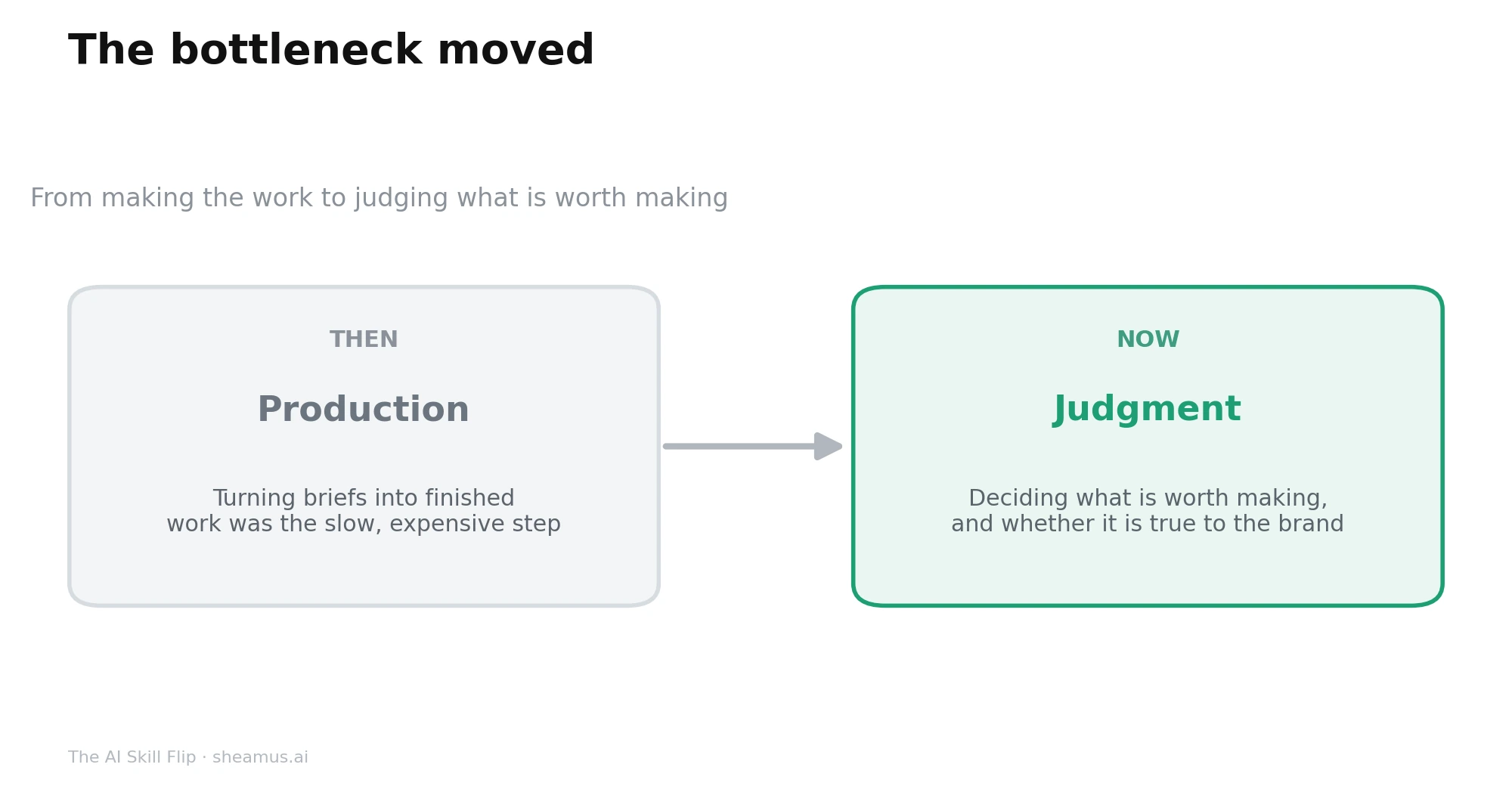
For most of marketing’s history, the constraint was production. Making the materials was the slow part. Writing the campaign, drafting the emails, cutting the ad variants, building the landing page, producing enough creative to feed every channel. A good marketer was often the one who could turn a brief into finished work quickly and keep the volume up. Teams were sized around that constraint, which is why so many junior roles existed to produce at scale.
That constraint has loosened, faster than most workflows have adjusted to. A marketer with a current AI stack can generate a month of social copy, twenty ad variants, and a first-draft landing page in an afternoon. What has changed is that the raw making of the materials is no longer the slow, expensive step, so it is no longer where most of your value comes from. The bottleneck has moved to judgment: deciding what is worth saying, to whom, in a voice that sounds like your brand, and being right about whether it will actually move the needle. Julie Bedard of Boston Consulting Group, speaking on the Hard Fork podcast, estimated that a marketing manager’s tasks are roughly 90 percent disrupted at the skill level. The role remains, and the skills that define it are being reshuffled underneath it.
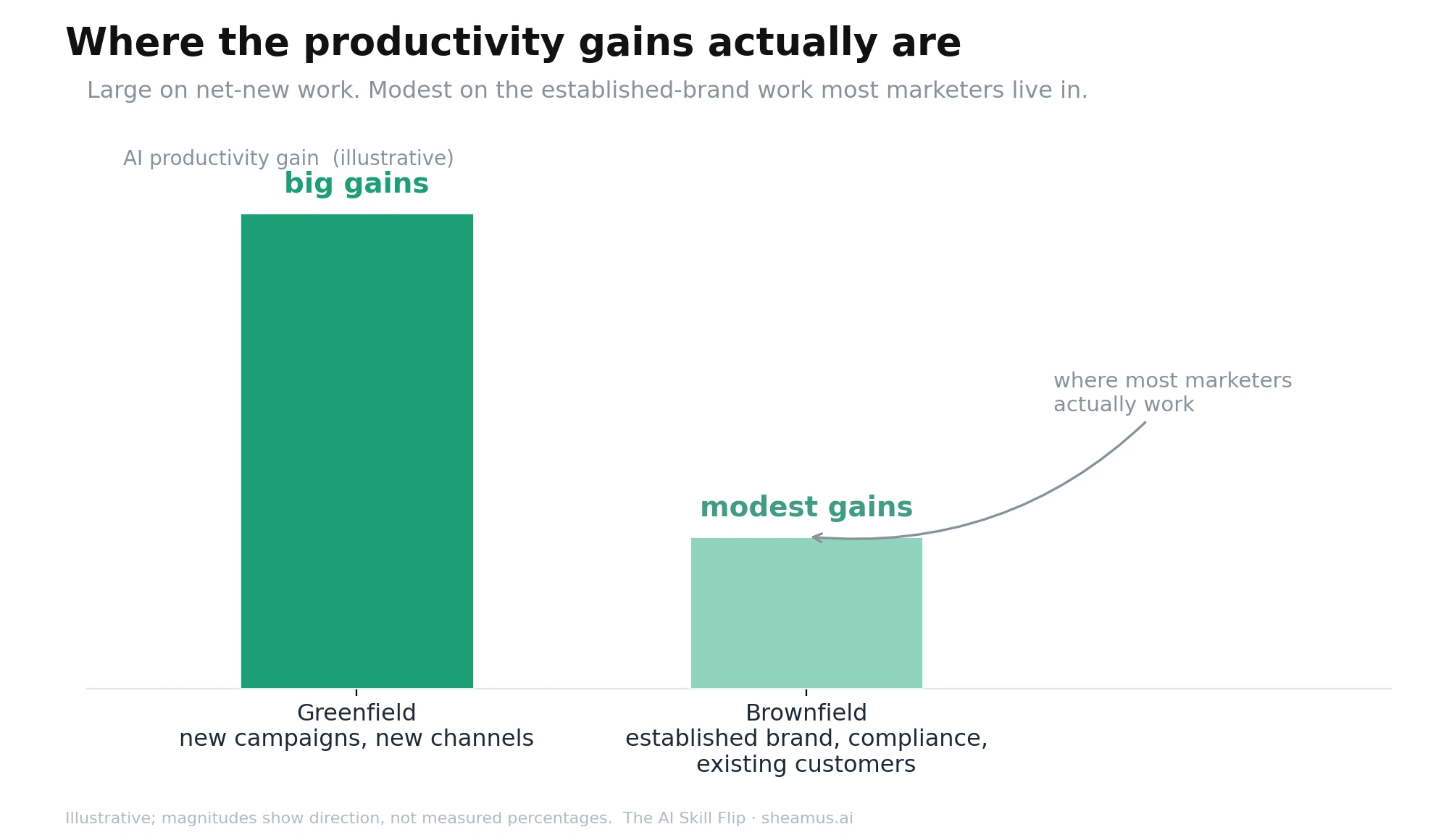
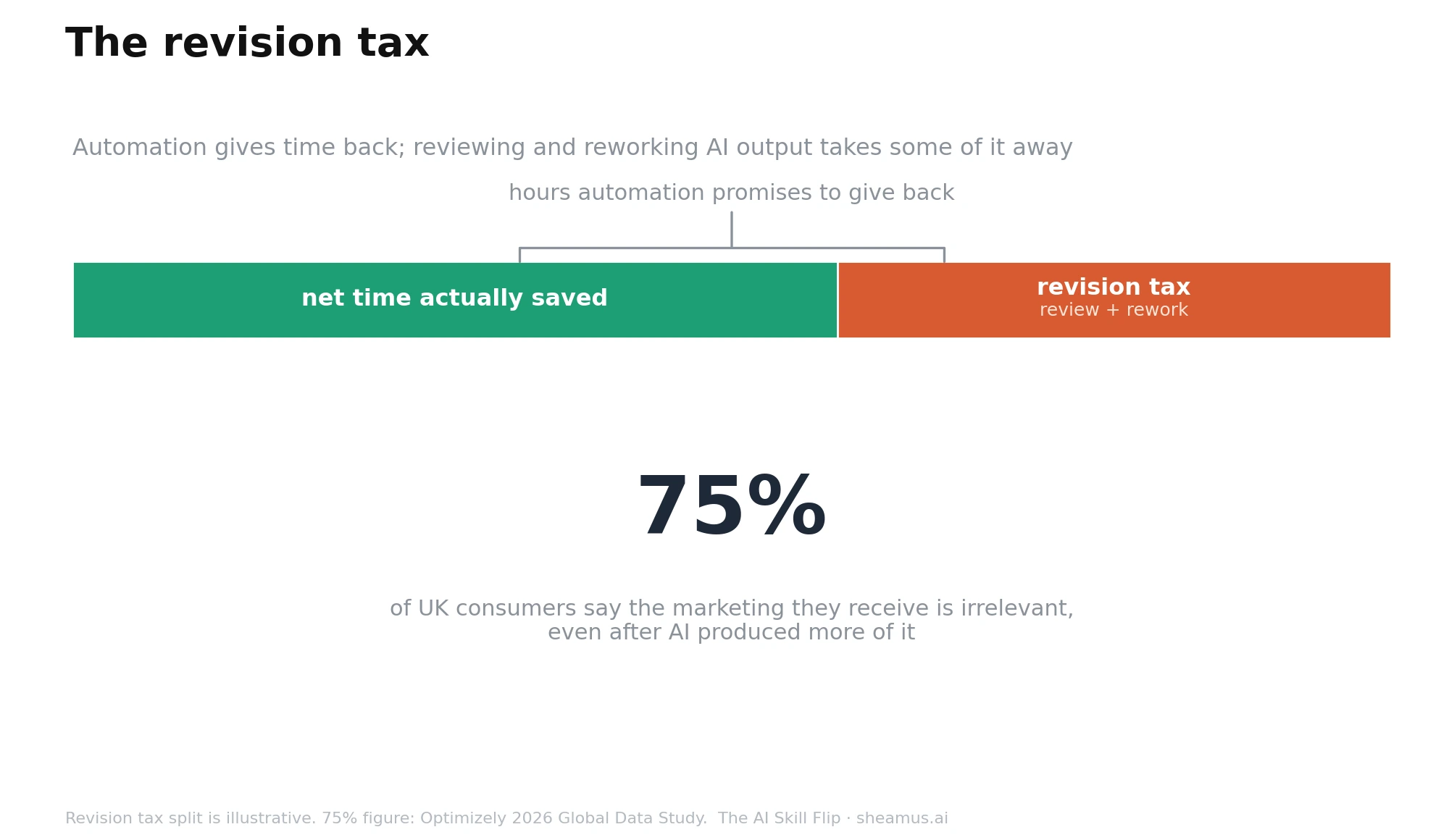
One thing to note. The largest productivity gains show up in net-new work. Spinning up a fresh campaign, generating volume for a new channel, producing variants where there was nothing before. That is the greenfield case, and the gains are real and significant. The picture is more modest in the brownfield case, which is where most marketers actually live: an established brand with a distinct voice, legal and compliance review, existing customer relationships, and a quality bar that generic output does not clear. McKinsey’s Global AI Survey. Case in point: it found that although AI adoption is now widespread, only around six percent of organisations were capturing meaningful bottom-line impact from it. That distance between the demo and the deposit is the Hype Gap. The time savings are real, often several hours a week per marketer. The value only shows up when judgment is applied on top. A 2026 Optimizely study captured the gap in real terms: three quarters of UK consumers said the marketing they receive is irrelevant, even after AI flooded their channels with more of it, while marketers reported a growing revision tax, the rework time that eats the hours automation was meant to save.
Illustrative estimates
The Skill Flip: Marketers
How AI adoption shifts which marketers skills matter more.
Illustrative synthesis based on 2025–2026 surveys, practitioner accounts, and industry research. Bar lengths show relative direction and magnitude, not measured percentages.
Skills that are receding.
Receding does not mean gone. It means AI now produces a usable first draft, so your value stops coming from doing the thing and starts coming from knowing enough to catch it when it is wrong.
First-draft copy at volume. Product descriptions, social posts, ad variants, nurture emails, the standard blog post. This was the daily grind of junior copywriting and content roles. AI drafts it fluently now. Knowing how to write still matters enormously, but it matters as the ability to tell a good draft from a bad one, not as the ability to produce the fortieth product description by hand.
Templated production and asset resizing. Taking one piece of creative and cutting it into fifteen formats for every placement and channel was a real job that consumed serious hours. Generative tools and platform features handle most of the resizing and reformatting now. What still requires a person is the judgment about which creative deserves the effort.
Keyword research and SEO first drafts. Assembling keyword lists, drafting meta descriptions, and producing the optimised-but-forgettable page was a reliable entry-level task. AI does the assembly faster. And with more search now happening inside AI answers rather than blue links, the mechanical version of this skill is receding twice over, once to automation and once to a changing channel.
Manual campaign assembly and routine reporting. Setting up the ad sets by hand, building the variants, pulling the weekly dashboard together. Automated platforms like Google Performance Max and Meta Advantage+ already absorb much of the setup and optimisation, and AI handles the first pass of the reporting narrative. Reading the report correctly and deciding what to do about it is the part that stays.
Skills that are rising.
These are the skills the data and the marketers I interviewed for this piece keep pointing to. Each comes with a note on how to actually build it, because that is the part generic AI-future hype pieces generally skip.
Positioning and strategic judgment. When anyone can generate a competent campaign in an afternoon, the competent campaign is worth far less. The more valuable thing is deciding what to say, which audience to say it to, and what to deliberately leave out. It is the hardest thing for AI to do, because it depends on a point of view the model does not have and cannot invent.
How to build it: before you open any AI tool, write a one-page positioning brief in your own words. Who this is for, what they currently believe, what you want them to believe instead, and the single idea the work has to land. Do it every time, even when it feels slower. Then hand that brief to the AI. What it produces that misses the point shows which parts of your thinking were still fuzzy.
Brand taste and editorial judgment. AI output converges on the average of everything it has read, so it is fluent but generic by default. The rising skill is the taste to know when something actually sounds like your brand instead of like everyone else’s. It also means being willing to kill a draft that is merely fine and knowing what good or even excellent looks like. Marketers who lack this skill ship more content and get less for it, because the audience has learned to scroll past anything that reads like AI wrote it.
How to build it: keep a brand voice reference, a short document of real lines that sound like you and real lines that do not, with the reasons why. Run every AI draft against it and edit hard. Over time you are training your own judgment as much as the tool, and that judgment is the asset that transfers.
Audience, product, and competitor insight. This is where the hours that quicker production frees up should go. AI can sketch a persona in minutes and summarise a rival’s website on demand, but it cannot sit in on your sales calls, live inside your own product until the rough edges show, or tell where a competitor is genuinely strong. This firsthand understanding is where true competitive positioning is built, and the model has no real access to it. If making things (content etc.) got cheaper, the freed time is wasted unless the marketing professional moves to the work AI does poorly. This is the competitive and career advantage.
How to build it: Spend the time saved on production work to do what only a person can do. Talk to real customers on a weekly basis. Use your own product the way an impatient buyer would, until you feel what is missing. Go through a competitor’s funnel, sign up, read the onboarding, watch how they sell, then feed what you notice back into the work instead of the version a model guessed at.
Optimising for AI visibility (AI Search). This one didn’t exist a year ago. More buyers now begin inside an AI assistant instead of a search box, so your audience has quietly grown to include the models themselves. The marketers I interviewed for this piece described AI search as “a full-on channel,” not a curiosity: they track organic AI traffic separately from search and report real gains in visits and signups.
How to build it: add a clear FAQ block to your key pages and mark the content up with schema so models can parse it, then track AI-referred traffic as its own line. Do not carpet every page in FAQs, the current failure mode. The aim is to be the source a model quotes, which starts with being legible to it.
Orchestrating AI teammates (AI workflows). This is where marketing moves from doing to directing. The higher-value version of the job is designing a workflow where AI agents handle outreach, nurture, enrichment, and follow-up with some autonomy, while you set the goals, the guardrails, and the standard of acceptable output. Tools like Claude Cowork and Clay make this reachable without a technical background. This is the Tools to Teammates shift, a genuinely new skill closer to managing a small team than to using software.
How to build it: pick one workflow you currently neglect because there is never enough time, dormant leads, post-webinar follow-up, review responses, and build an agent to run it. Keep a running correction log, every time it goes off-brand or off-target and the rule you added to stop it recurring. That log is how the system gets good, and maintaining it is the skill. The teams doing this well build in a hard stop: the agent must ask before it spends money or touches a customer, so a human signs off on anything that matters.
Measurement and distribution judgment. When producing is cheap, the constraint moves to attention, and knowing what actually moved the needle becomes the difference between spending and investing. As you well know, AI will happily generate more of whatever you ask for. Deciding what is worth making and if it will actually reach people is the human skill that gets more valuable as the volume of output climbs.
How to build it: before launching anything, write down the one metric AI is supposed to move and what a real result would look like, then hold the work to it afterward. This will guard against the most common AI-era failure, producing a great deal of content that performs poorly.
The taste premium.
Across the rising skills there is one common thread. The marketers pulling ahead are not the ones generating the most. They are the ones who have become most ruthless about what deserves to exist. Everyone now has access to infinite competent output, so competent output has stopped being an advantage and started being noise at best or AI slop at worst. The advantage has moved to the judgment that decides what to publish, what to kill, and what to say that no model would have produced on its own.
This is calibrated skepticism that you need to apply to your own output. It’s the skill to treat every AI draft as a starting point to be sharpened or thrown out, but never as finished work. It makes positioning sharper, because the idea gets interrogated thoroughly and shows up in brand work that goes well beyond the generic version.
The counterintuitive part is that using AI well in marketing often means producing and publishing less, not more. What my book and others call cognitive debt is what accrues when a team lets the model think for it and quietly forgets what good is.
The new shape of the role.
The clearest way to see where this is heading is to look at the roles it is creating. In my book I spoke with Ashleigh, whose title, GTM AI Engineer, did not exist until recently. She has no coding background. What she has is the ability to translate between what AI can do and what the business actually needs, and she used it to build an AI teammate that reached out to thousands of dormant leads with a level of personalisation a human team could not match at that scale. She was not automating herself out of a job, she was inventing one. That is the shape of the role the flip is producing, part marketer and part orchestrator and defined by judgment about where to point the machines rather than by the hours spent producing.
The Skill Flip, in plain terms.
The career goal for marketers now is to build in that direction: toward positioning, orchestration, and the insight AI can’t manufacture, and away from the production skills that are now just table stakes.
Generating first-draft copy at volume, templated production, mechanical SEO, manual campaign setup and routine reporting. These are the receding skills. They are becoming the baseline and they will no longer differentiate you.
Instead what differentiates you is positioning, brand taste, firsthand understanding of your customer and your product and your competition, understanding AI visibility, agent orchestration, and measurement judgment — these are the rising skills. They are harder to learn and harder for AI to copy, and they are where the professional gap is opening.
So the bottleneck moved from producing the work to judging what is worth making. The marketers who move with it are the ones who will pull ahead. That is the Skill Flip for marketing, and it is well underway.
This article is part of a series expanding on the ideas in The AI Skill Flip, examining what rising and receding skills look like role by role across the professions most affected by AI. Next up: sales.
Resources to build the rising skills
AI visibility & AI search
- Structured Data for AI Search: Schema Markup Guide — How to use accurate schemas so search engines and AI systems can interpret your pages more reliably
- Google: Generative AI Features in Search — Google’s official guidance on earning visibility in AI-powered search through helpful, original, technically accessible content
- How to Choose an AI Visibility Provider — A practical guide for evaluating AI-search visibility platforms
AI workflows & orchestration
- Claude for Marketing Ops and Analytics — A recorded session on how Anthropic’s marketing team uses Claude Cowork for recurring marketing operations, analytics, reporting, and webinar-campaign workflows
- How Anthropic’s Team Uses Claude Cowork — An on-demand session offering real-world examples of how Anthropic teams incorporate Claude Cowork
- Anthropic: Building Effective AI Agents — A practical guide to choosing between predictable workflows and more autonomous agents, with emphasis on simplicity, guardrails, and testing
- Zapier University — Training and examples for automating multi-step work across marketing, CRM, email, and data tools
- Clay University — Learning resources for AI-assisted enrichment, prospect research, and scalable outbound workflows
- HubSpot Academy: AI for Marketing — A free introductory course covering AI-supported strategy, campaigns, reporting, prompting, and responsible marketing use
Positioning & strategy
- Obviously Awesome — April Dunford. A practical framework book for defining competitive alternatives, differentiated value, target customers, and category
- How Brands Grow — Byron Sharp. A classic evidence-based marketing strategy book explaining how brands grow
- The Mom Test — Rob Fitzpatrick. A short, practical guide to customer conversations that helps marketers avoid biased feedback
Brand taste & editorial judgment
- The Brand Gap — Marty Neumeier. A concise guide to connecting business strategy, design, and distinct brand expression
- Zag — Marty Neumeier. Helps teams find and articulate the one thing that makes their brand meaningfully different
- Grammarly Business Style Guides — A useful reference for creating a consistent voice, tone, and writing standard across a team
Customer, product & competitor insight
- Jobs to Be Done — Introduces a customer-understanding framework based on the progress people are trying to make
- Gong Labs — Research and practical analysis of sales conversations, objections, buying behavior, and revenue messaging
Prompting, evaluation & governance
- OpenAI Prompting Guide — Practical techniques for defining tasks, supplying examples, and evaluating model outputs
- Anthropic Prompt Engineering — Guidance on writing clear prompts, supplying context, structuring tasks, and improving AI output quality
- NIST AI Risk Management Framework — A credible framework for managing AI risks involving privacy, bias, reliability, safety, and accountability
- OECD AI Principles — International principles for trustworthy AI, including transparency, robustness, privacy, and human accountability