Every profession has a skill stack. The things you spend your time on, ranked by how much they define your value. Despite the "coding is dead" headlines, AI is not removing skills from that stack. It is reordering them.
Not by eliminating skills, but by changing which ones matter. Some skills are rising, absorbing more of your working day and carrying more of your value. Others are receding, still necessary, but no longer where the real work happens. What's receding becomes the baseline and what's rising is where the gap between good and average now lives. This is the Skill Flip, and it looks different depending on where you sit.
Based on my recent book The AI Skill Flip, this is the first in a series expanding on what the flip looks like role by role. We start with software engineers, the profession closest to the tools and one I have spent much of my professional career in. What is happening to them now is a preview of what is coming for everyone else.
The bottleneck has moved.
For most of software engineering's history, the constraint was execution. Writing code was the hard, slow part, and while it could be exhilarating at times, I personally found much of it grueling. Product managers wrote requirements, coders implemented them, and the measure of a good engineer was how well they knew the syntax and how fast and cleanly they could turn a spec into working software. Fast was one of the reasons I learned to touch type in the 90s. I wanted to be faster and better than my colleagues. That model has now collapsed.
The teams building the best software in 2026 are not the ones with the fastest coders. They are the ones who are most precise about what they are building and why. As the MarketKloud Engineering Report (Q1 2026) put it, the biggest risk in AI-native engineering is not that AI writes bad code. It is that AI helps you build the wrong thing with extraordinary efficiency. The bottleneck has moved from technical execution to product judgment.
One important caveat. The productivity numbers you hear about, the 20x and 100x claims, mostly come from developers building new codebases from scratch. I build new applications and maintain existing ones, and there is an orders-of-magnitude difference in AI productivity gains between the former and the latter. This is the industry norm. Google has over 100,000 engineers working on billions of lines of existing code. Google's CEO, Sundar Pichai was quoted in the New York Times that they see roughly 10% improvement in engineering output on average. That is still meaningful since they are mostly working in brownfield code and most engineers are not building greenfield apps. They are maintaining systems that have been running for years. The productivity gains are real, just more honest than the 100x headlines suggest.
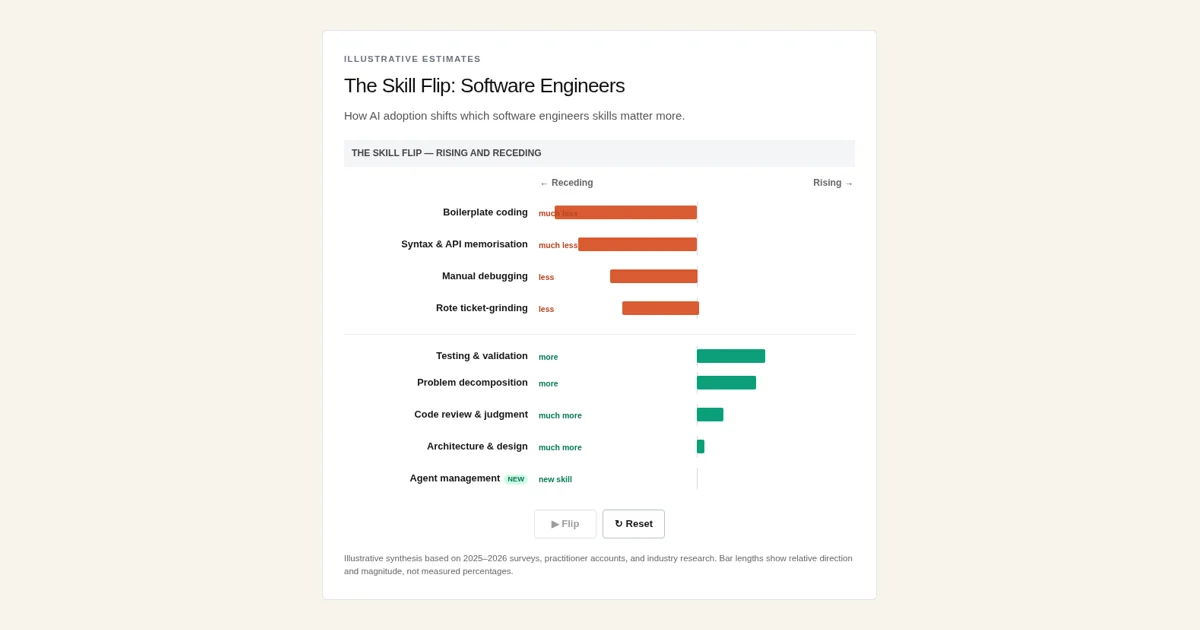
Illustrative estimates
The Skill Flip: Software Engineers
How AI adoption shifts which software engineers skills matter more.
Illustrative synthesis based on 2025–2026 surveys, practitioner accounts, and industry research. Bar lengths show relative direction and magnitude, not measured percentages.
Skills that are receding.
Receding does not mean gone. It means AI now handles the first draft well enough that your value no longer comes from doing just these things. It comes from knowing enough about them to catch when AI gets them wrong.
Boilerplate coding. Writing CRUD operations, scaffolding endpoints, standard refactors, this was the bread and butter of junior to mid-level engineering. AI handles it fluently now. If a tool produces a correct first draft in seconds, spending an hour on it by hand is not craftsmanship. It is inefficiency.
Syntax and API memorisation. Knowing a framework's entire API cold used to signal seniority. It no longer does. AI suggestions plus quick verification is faster and accurate enough that the premium on recall has dropped sharply. What matters now is knowing enough to evaluate what AI suggests, not knowing it all from scratch.
Manual debugging and rote ticket-grinding. Stepping through familiar errors by hand, grinding through repetitive implementation tickets, this was how juniors built pattern recognition. AI now proposes hypotheses, generates log queries, and suggests fixes faster than most engineers can open a debugger. The skill has moved from doing to verifying.
There is a reason software engineers have embraced this more willingly than almost any other profession. In an excellent New York Times Magazine piece on the subject, Anil Dash, a longtime programmer and tech executive, put it well: in creative disciplines, AI absorbs the soulful parts of the work and leaves the drudgery to the human. In coding it does the opposite. AI takes the drudgery and leaves the thinking. That asymmetry explains the unusually high adoption rate in this field.
Skills that are rising.
These are the five skills the data and practitioner accounts consistently point to. For each one, there is a short note on how to actually build it.
Architecture and design.
This is what many are calling the shift from bricklayer to architect. Developers now focus on the overall shape of the software, how components fit together and what happens when they fail, while agents handle implementation. AI can scaffold a service quickly. What it cannot do is choose the right failure isolation strategy for a payments system, or decide how a data model should evolve when the business changes. Those decisions require a human who understands the system in context, not just the function in front of them.
How to build it: Many developers I talk to advise stopping reaching for the keyboard first. Before starting any non-trivial feature, write a short design document, even half a page, covering the approach, the tradeoffs, and the failure modes. Do it even when it feels unnecessary. The habit of thinking before implementing is the muscle and new skill you are building. Study architecture patterns and anti-patterns and understand non-functional requirements. Read architecture case studies and study how systems you depend on are actually designed, not just how to use them.
Problem framing and decomposition.
Getting good output from an AI agent is not about finding the right prompt formula. It is about taking a fuzzy requirement and structuring it into a well-defined problem with clear constraints, then expressing it precisely enough for the AI to actually solve it. Engineers who do this well are doing hard engineering work, just at a higher level of abstraction than before.
How to build it: Practice writing specs before you build. Take any task you are about to start and write down exactly what done looks like, what the edge cases are, and what the constraints are. Then give that to an AI agent and see what breaks. What the agent misses is what your spec failed to express. Over time you get better at both the thinking and the expression.
Agent management.
This is a genuinely new skill, though managing automated systems has existed in computing long before large language models. What is new is the behavioral unpredictability. Engineers who use AI deeply maintain a rulebook for their agents, a running record of every time the AI went off script and the guardrail added to stop it recurring. This is the engineer's system prompt file, and it is an emerging practice of working with a system that is generally competent but unpredictably deviant.
How to build it: Start a system prompt file. Every time an agent does something you did not want, add a rule. Every time you have to correct the same mistake twice, that correction becomes a standing instruction. Treat it the way a good manager treats a playbook, something you refine over time based on what actually happens, not what you theorised would happen. If you want to go deeper on the mechanics of communicating with AI as a professional skill, Chapter 7 of The AI Skill Flip covers prompting not as a technical exercise but as a human one, and it is where most people find the biggest immediate improvement.
Code review and judgment.
When most of your code starts as AI output, review is no longer a quality gate. It is the primary site of engineering judgment. You are no longer checking that a colleague followed style conventions. You are asking whether the generated solution is the right design, whether it is secure, whether it will hold up in two years, whether it contains the architectural shortcuts that AI review consistently misses. The engineers who are most valuable now are the ones who have developed taste, not just technical knowledge.
How to build it: Review AI-generated code more thoroughly than you review human-written code, not less. The temptation is to trust it because it looks clean. Resist that. Ask explicitly: is this the simplest correct solution, or just a working one? Would I have designed it this way? What has the AI optimised for that I did not ask it to optimise for? That last question catches more problems than any other.
Testing and validation.
AI is very good at generating output but not good at judging the value of that output. It can also generate tests at volume. What it cannot do is decide what correct means. Designing acceptance criteria, understanding which edge cases matter in this specific system, knowing which generated tests are checking something real versus passing vacuously, that judgment is irreplaceable. The speed at which AI generates code has raised the stakes on testing because the volume of code to validate has gone up sharply.
How to build it: Write your test criteria before you write, (or ask your AI agent for), any code. Define what passing looks like in plain language first. This forces you to think about correctness independently of implementation, which is exactly the judgment AI cannot replicate. Then use AI to generate the actual test code against your criteria, and audit what it produces against what you specified.
The programmer in the loop.
Across all five rising skills there is a common thread. The engineers who are outperforming in 2026 are not the ones who use AI most. They are the ones who use it most skeptically. The most common workflow description among high performers, from a survey of roughly 900 engineers by The Pragmatic Engineer (February 2026), was some version of: I use it for everything, but I am still very much in the loop. A split-screen setup with an agent running in a terminal and an IDE open to review its changes is the default, not because they distrust the tool entirely, but because they have learned exactly where it gets things wrong.
That calibrated skepticism shows up everywhere the rising skills live. It produces better specs because you question the requirement before handing it to an agent. Additionally, it produces stricter reviews because you know where AI takes shortcuts and it produces better tests because you treat AI-generated test suites as a starting point, not as a completed product.
The skill flip, in plain terms.
Boilerplate coding, syntax & API memorisation, manual debugging, rote ticket-grinding. These are the receding skills. They are becoming the baseline, the minimum you need to catch AI mistakes. They will no longer differentiate you.
Architecture, decomposition, agent management, code review, test design. These are the rising skills. They are harder to learn, but also harder for AI to replicate. And this is increasingly where the real professional gap opens up.
So the bottleneck moved. The engineers who moved with it are the ones pulling ahead. That is the skill flip. And it is just getting started.
This article is part of a series expanding on the ideas in The AI Skill Flip, examining what rising and receding skills look like role by role across the professions most affected by AI. Next up: marketing.